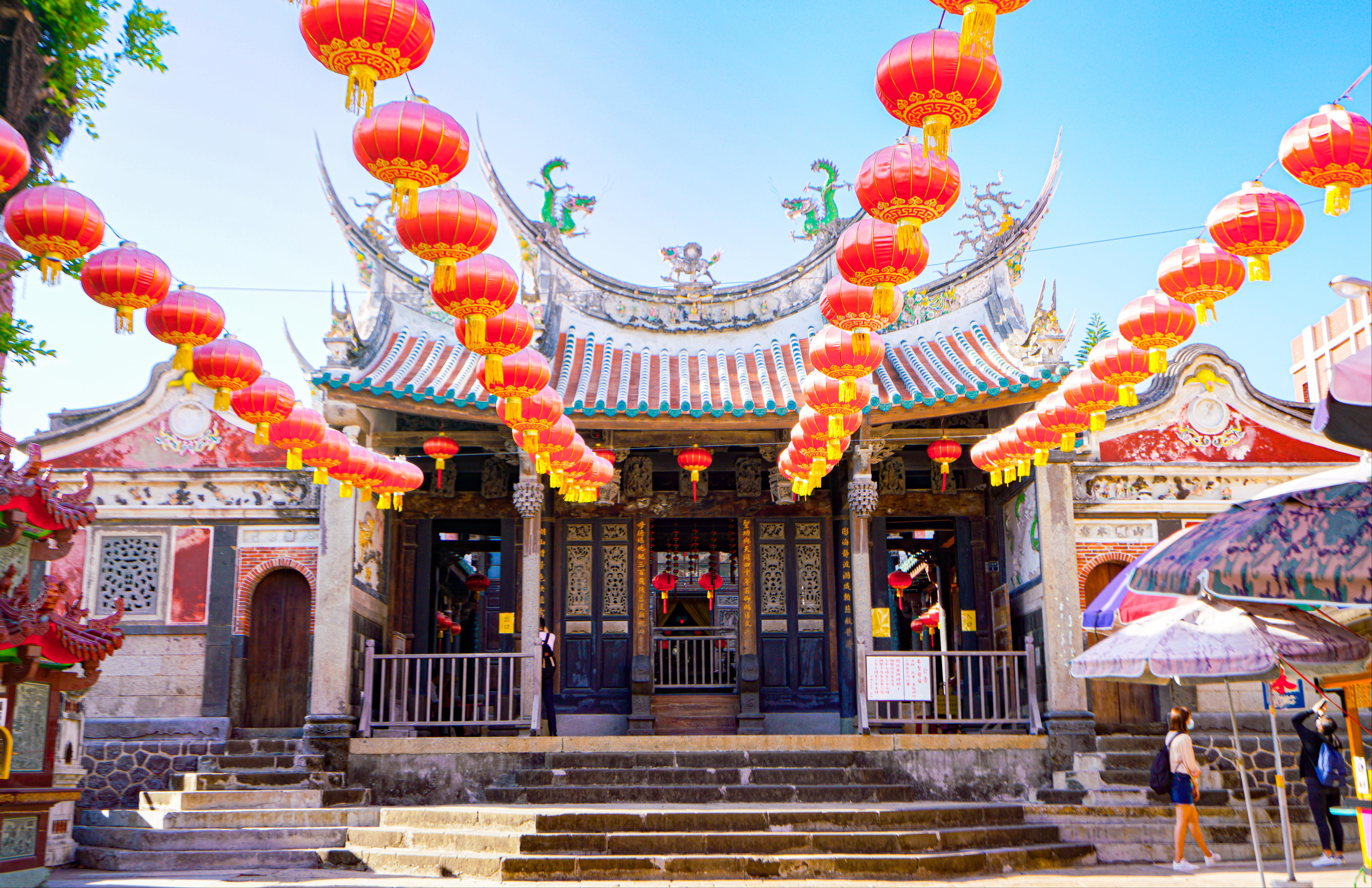
Penghu Tianhou Temple Introduction
For the people of the sea, the sea guardian deity - Mazu is undoubtedly an important spiritual support. Penghu Tianhou Temple is the earliest Mazu temple established in Taiwan and is designated as a "national historic site." In the early days, fishermen from the coastal regions of Fujian, China would honor Mazu on their boats for safe voyages, and later, after settling in Penghu, they built temples on land to worship her. Time flies, and it has protected the people of Penghu for over 400 years. It was known by various names such as "Niangong," "Niangniang Palace," "Niangma Palace," "Madaughter Palace," and "Mazu Palace," with even the ferry terminal referred to as "Mazu Palace," abbreviated as "Magong." Because "Magong" and “Mazu Palace” are homophones in Japanese, and "Magong" is easier to identify due to its few strokes, the Japanese military marked Magong on military maps before occupying Taiwan and Penghu. After the Japanese took control of Taiwan, they set up the Magong Harbor Office in Penghu in 1901, but the administrative area still retained the Qing Dynasty name "Maguangao." It wasn't until 1920 that "Maguangao" was changed to "Magong Street," which officially became the origin of the name "Magong." Tianhou Temple is not only a landmark of Magong but also a spiritual symbol of Penghu. With its rich history, its architectural features are also intriguing. The temple consists of three sections: the front (Shanchuan Hall), central, and rear halls, each guarded by a dragon on either side. The hall's sign is intricately carved with three dragons entwined, vividly depicting their expressions. Despite years of wear, the craftsmanship is still appreciated. The beams and columns at the entrance feature lion bases and various dougong brackets to support the beams and roof, with interior carvings illustrating stories such as "Zhao Zilong Rescuing His Master." The main hall's screen doors are adorned with carvings of auspicious symbols representing the four seasons, symbolizing peace and longevity throughout the year, showcasing exquisite craftsmanship that can be considered a high-end example of carpentry. Star Attraction: With a history of over 400 years, Penghu Tianhou Temple is the earliest temple in Penghu. To ensure a smooth filming process, many film crew members visit this place to burn incense and pray to Mazu for blessings when they encounter issues during outdoor shoots. It is said that problems can be easily resolved, proving to be very effective. The album "Road to Life" by the Golden Melody Award-winning singer Jhan Yawen features all its music videos filmed in Penghu, where the MV for "Penghu Love Song" showcases the temple's ancient and elegant exterior, as well as the finely carved wooden sculptures.