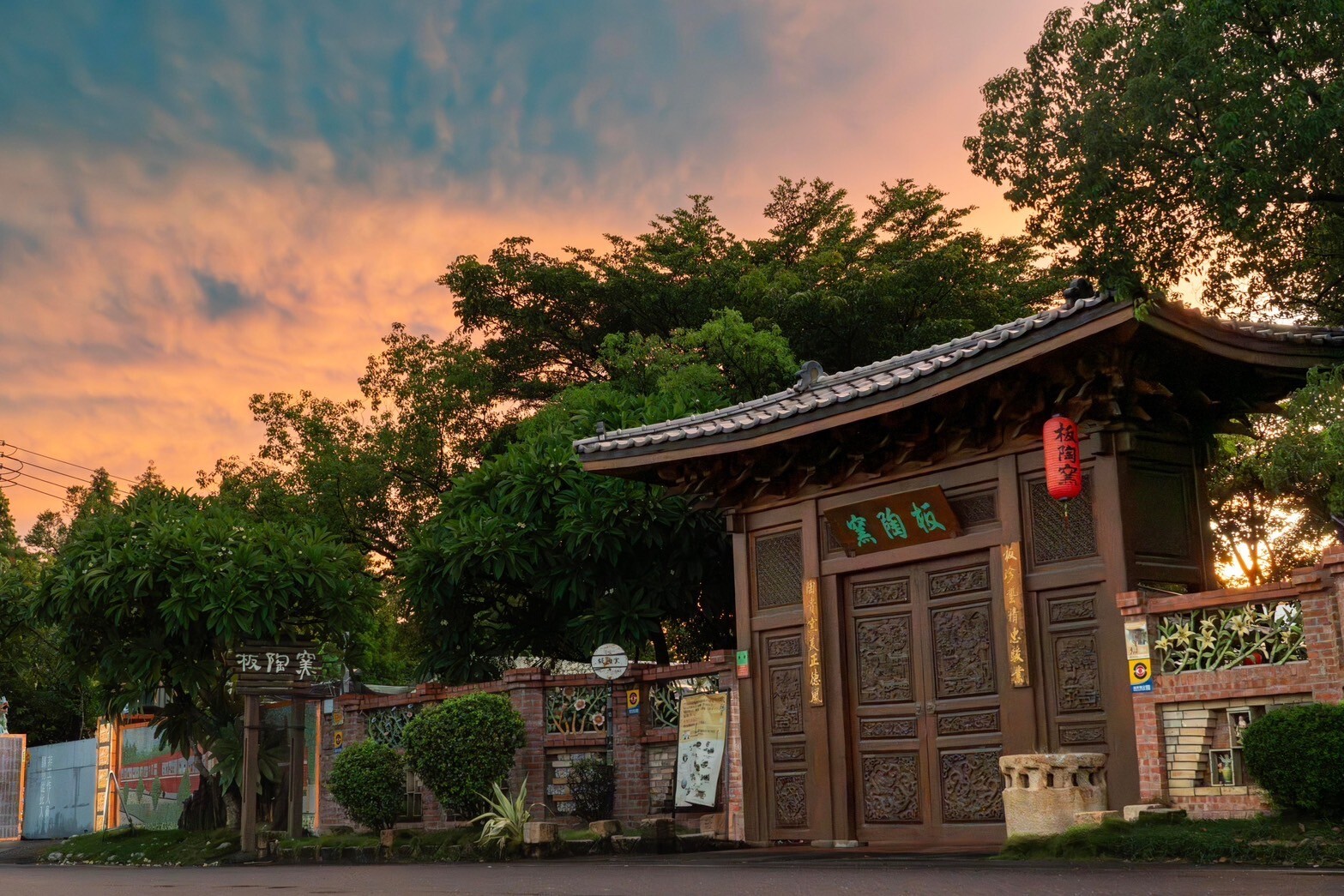
Ban Tao Kiln Jiaozi Cut-and-Paste Crafts Cultural Base Introduction
1. Origin of Jiaozi Pottery Jiaozi Pottery is the most distinctive traditional cultural art of Chiayi, the name "Jiaozi" refers to the area south of Guangdong during the Han Dynasty. At that time, it was known as "Jiaozi Wengzi" and "Miao Weng," originally used as decoration on traditional temple buildings and wealthy residences, famous for the vivid representations of characters in stories of loyalty, filial piety, and righteousness. In Taiwan, Jiaozi Pottery mainly consists of two major systems, represented by Ye Wang with gemstone glaze and Ke Xun and Hong Kunfu with watercolor glaze. Ye Wang's works focus more on sculptures and lines, with the bright colors of the gemstone glaze as a significant characteristic of Jiaozi Pottery. Ke Xun from Tong'an County, Quanzhou, arrived in Taiwan in the early Japanese colonial period. His younger brother Ke Ren and his apprentice Hong Kunfu accompanied him to Taiwan to work on the Beigang Chaotian Temple in Yunlin, and after finishing, they returned to the mainland. During the Qing Dynasty, scholar Lin Weichao called for the reconstruction of the Jiayi Xinkang Fengtian Temple and requested the builders to invite Hong Kunfu to craft the temple's Jiaozi pottery. The characteristic of Hong Kunfu's Jiaozi pottery works is “emphasizing form and light on details,” where the figures harmonize with the background, emphasizing character shape while prioritizing spirit, followed by the exhibition of techniques and detail portrayal. Therefore, the proportions of Jiaozi pottery figures' limbs are slightly longer than their bodies, particularly noticeable in the thighs. During the production period, he resided in the Yanshui Port area of Chiayi and began teaching his techniques and skills, frequently traveling back and forth between the mainland and Taiwan. Hong Kunfu had many apprentices in Taiwan, in order of learning: Mei Jingyun, Shi Lianchi, Chen Tianqi, Zhang Tianfa, Chen Zhuanyou, Yao Zilai, Jiang Qinglu, and others, spreading all over Taiwan, forming a vast inheritance system, being the mainstream of today’s temple cut-and-paste and Jiaozi pottery. 2. Cut and Paste Art Cut and paste art, also known as flower cutting art, is a form of folk art with a long cultural history. Early temples in Taiwan used it as decorative elements for ridge tops or walls, with bright colors that reflect sunlight and showcase the society of the time. Cut and paste is a traditional craft that originated from Tangshan in Mainland China, gradually developing into artistic creations and installation art. Literally, cut and paste means to cut first and then stick; it utilizes broken pieces of porcelain or bowl shards, trimming the material into the necessary shapes, cutting the porcelain into various shapes, and using glue to stick them onto the shaped structure. This is a very time-consuming and labor-intensive task, as artisans must securely adhere the porcelain pieces to the rooftops, often taking a long time to work on the rooftops during construction. Cut and paste artworks can last for hundreds of years, often conveying meanings of religious faith and virtuous customs. 3. Ban陶 Kiln Cultural Development Association The Ban陶 Kiln Cultural Development Association was once an important form of installation art on Taiwan’s temples, which could potentially disappear in this materially abundant society. Conversations with several artists revealed the difficulties of inheritance: on one hand, parents do not want their children to endure the same hardships of this path; on the other hand, young people lack the time necessary to dedicate to learning a craft, which is particularly challenging for the Jiaozi cut-and-paste craft that can take three to five years to master. The Ban陶 Kiln Cultural Development Association hopes that this spirit of inheritance can be connected early on, allowing youth to remain in their hometowns to learn skills and continue to promote traditional crafts for future generations.
 Ox Turning the World
 Happy Paradise - Wang Guoliang