Hsinpu Baozhong Pavilion Yimin Temple Introduction
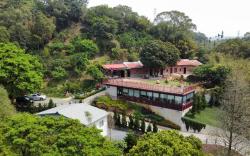
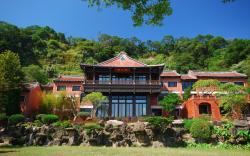
Yimin Temple is situated facing south, built against the mountains, on the Hozai Lake platform, overlooking the Fengshan Creek valley plain. The terrain is lower in front and higher in the back, with openings on both sides, creating a naturally magnificent scene. It is said that the location of the Yimin Tomb is one of the three famous burial spots in the Fengshan Creek basin, called "Xiongniu Kundi Xue," which is an excellent Feng Shui site. The area in front of Yimin Temple is spacious; in addition to the main temple structure and the large temple square in front, there is the Yimin Tomb and its accompanying tomb behind the temple, along with a vast surrounding garden, making it an important recreational destination in the county. The main building of Yimin Temple features a scale of "two halls, two corridors, and two horizontal houses," likely the result of renovations in 1904 (the 37th year of the Meiji era). The San Chuan Hall has a width of five bays, with the middle three bays narrowed into a corridor. The facade, adorned with exquisite wood and stone carvings, presents a central altar dedicated to the deity "Yue Dong Bao Zhong Yi Min," with a small room above the altar for the imperial edict plaque. A royal plaque reading "Bao Zhong" hangs from the main beam, both important cultural relics of the temple. To the left and right of the main hall are deities such as San Shan Guo Wang, Guanyin, and Wu Gu Ye, while the right-side shrine is dedicated to the God of Wealth and other significant figures. Between the San Chuan Hall and the main hall is a courtyard, augmented by a rain shelter to increase the ritual space. The two sides of the courtyard contain corridors, three bays wide and two bays deep. The back part of the central bay is separated by a flying roof, housing altars for the founding figures of the temple, including Lin Xiankun, Liao Zhaochen, and Chen Ziyun. The left side is dedicated to figures such as Wang Tingchang and Qian Maozu, among others. The numerous plaques within the temple, including many from the Qing Dynasty and one gifted by Governor-General Hasegawa Kiyoshi reading "Serve the Country with Loyalty," are significant cultural artifacts of the temple. The hill behind the temple is the site of the Yimin Tomb, where the remains of the Yimin army are buried. Due to the large number, the scale is also significant, with the current appearance of the Yimin Tomb completed in 1923 (the 12th year of the Taisho era). In front of the tomb stands a stone tablet reading "The General Tomb of Yue Dong Bao Zhong Yi Min." The tomb is shaped like three curves, with a semi-circular burial ground in front, a golden pavilion on the left, and a stone tablet for the God of Wealth on the right. Not far behind to the left of the Yimin Tomb is the accompanying tomb for those who sacrificed their lives during the Taichao Spring Rebellion, which is smaller in scale.