Nanyang Hall Deng House, Guanshi Introduction
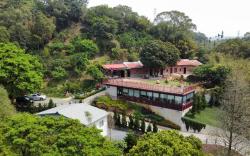
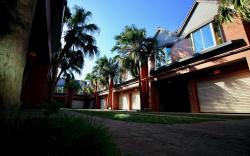
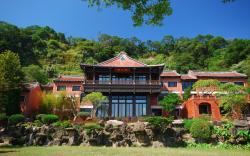
Nanyang Hall of the Deng Family in Kuan Hsi carries the historical memories of the Deng clan. Originating from Raoping, Guangdong, the Deng family’s 12th ancestor, Deng Shiquan, crossed the sea to Taiwan, initially settling in Xinzhuang, Taipei. In the late 18th century, due to family development, they purchased land in Dahan Keng, Hsinchu. However, during the Daoguang era of the Qing Dynasty, frequent conflicts between Fujian and Guangdong affected the Hakka Deng family, prompting the 14th ancestor to move the entire family to Dahan Keng, where they cooperated with other settlers to excavate the "Lao Kuan Liao Canal," build residences, and gradually develop into a settlement. The Deng family's "Nanyang Hall" is commonly referred to as the "old house" by clan members. Historical research indicates its initial construction dates back to the Daoguang era, while the building we see today was repaired in 1906 by craftsmen from Wufengpu, Xinpu. Nanyang Hall of the Deng Family is a typical Hakka courtyard building, featuring a layout of "one hall and three horizontal houses," with a rice terrace in front, a well, and a waste pit behind, fully showcasing the functional living characteristics of traditional Hakka sanheyuan (three-sectional compound). The main hall serves as a public hall, with the left and right horizontal houses for clan members to live in, while the outer horizontal house accommodates agricultural and livestock activities, such as raising cattle and pigs. The building materials are sourced locally, with black tiles, clay bricks, dou-gong bricks, and wooden frames reflecting the Hakka people's pragmatic and simple architectural style. The interior emphasizes feng shui, with the placement of earth dragon gods, Kitchen God, waste pits, and the hall of Tian Gong embodying the Hakka people's faith. Notably, the "integrated wooden door" and the design of "interconnected doors without side windows" in Nanyang Hall also consider security while embodying feng shui principles. The migration and development of the Deng family represent a typical case of second migration among the Hakka community and are closely related to the Han tenant history of the Zhuchan community. The descendants of the Deng family actively participate in local affairs, covering religion, education, and commercial development. Among them, the 18th descendant, Deng Jiazao, originally operated a medicine shop in Hsinchu City, but due to an outbreak of infectious diseases, his family was quarantined by the Japanese government, leaving only his wife, Chen Lianmei, alive. The medicinal powder he developed was later inherited and improved by the 19th descendant, Deng Shenghe, who created "Guangdong Mu Medicine Powder," which remains popular to this day. To strengthen family ties, clan members established the "Taiwan Deng Clan Shiquan Society" in 2014, ensuring the continuation of this precious Hakka lineage culture. Nanyang Hall of the Deng Family is not only a century-old residence but also a testament to the Hakka reclamation history of the Kuan Hsi area. Its complete architectural configuration and rich cultural connotations make it an important site that history and architecture enthusiasts cannot miss.