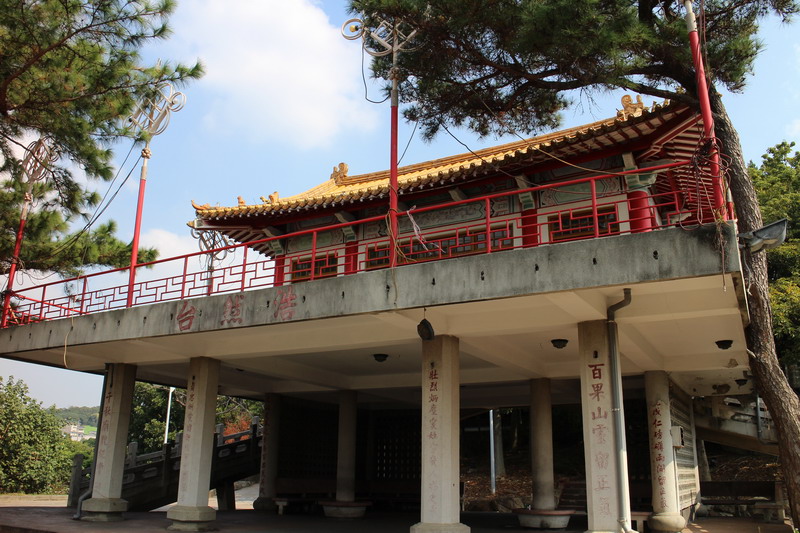
Yuanlin Shrine Ruins Introduction
During the Japanese colonial period, the Japanese built many shrines in Taiwan, which are places for worshipping deities. Shrines can be divided into official shrines and local shrines. Yuanlin Shrine was established in the 6th year of the Shōwa era (1931) and was originally an unclassified shrine. In the 17th year of the Shōwa era (1942), it was classified as a township shrine and is one of the shrines in Yuanlin District during the Japanese colonial period.
 Yuanlin Shrine enshrines the three deities of creation (Okuninushi no Mikoto, Sukei no Mikoto, and Ōkuninushi no Mikoto) and Prince Kanenori of Kitakawachi. The shrine has three torii gates leading from the worship path to the main hall, with the torii along the worship path redesigned in the style of traditional temple pavilions. On both sides of the worship path, stone lanterns, bronze horses, and lion seats are still preserved. In 1960, the main hall of Yuanlin Shrine was demolished and replaced with Haoran Terrace, which features a pavilion on the first floor and a war memorial shrine on the second floor, enshrining the spirits of "King Ming Yan-Ping," "fallen soldiers of the National Revolutionary Army," and "revolutionary martyrs." Source: Changhua County Cultural Affairs Bureau.