Yue Mei Shan Ling Quan Zen Temple Introduction
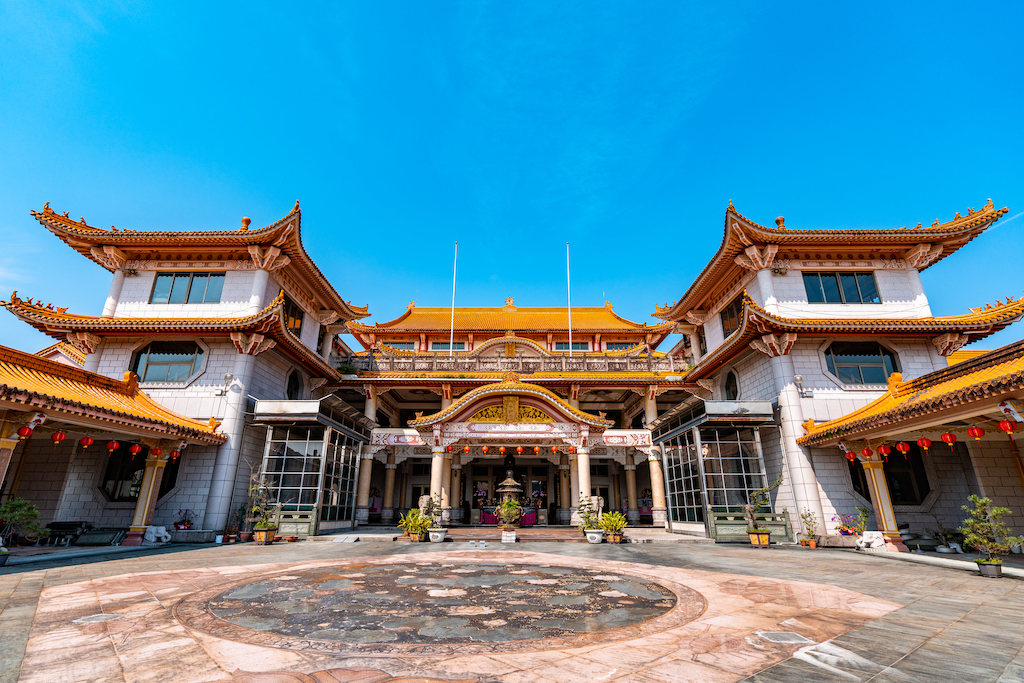
Just as its name "Zen" suggests, the secluded Lingquan Zen Temple stands on the slopes of Yuemei Mountain, surrounded by mountains and lush greenery, creating a peaceful "Zen realm" that calms the heart. Founded in the 31st year of the Meiji period (1898) during Japanese rule, it has a history of over a hundred years and is a well-known Buddhist temple in Taiwan. Lingquan Zen Temple is the first Zen temple in Taiwan with a monastery scale and is regarded as the origin of Buddhist temples in northern Taiwan, also known as the "First Temple of Northern Taiwan." A century ago, renowned monks from Fuzhou's Yung Chuan Temple, Shanzhi and Miaomi, came to Taiwan and propagated Buddhism at the Dainty Palace. As the number of followers grew, they decided to build another temple. A believer named Lin came forward and donated a piece of land for the construction, which began the following year. After the two initial monks passed away, the temple's construction was completed under the leadership of Master Shanhui, including the Buddha hall, founding hall, and Zen hall. The temple features a courtyard-style architecture constructed with brick, tile, wood, and stone, embodying a simple ancient style. After several renovations, the new mountain gate is quite magnificent, as is the Grand Buddha Hall. In the main hall, Guanyin Bodhisattva is enshrined in the front hall, flanked by the Four Heavenly Kings. The back hall is the main shrine enshrining Shakyamuni Buddha. To the right of the main shrine is the Relic Hall, housing the jade reclining Buddha, while to the left is the ancestral hall, which displays the memorial tablets of the ancestors. The sacred statues within the temple including the Dharmapala Zhutian, the Bodhisattvas, and the Sixteen Arhats, were sculpted by the renowned craftsman Lin Qifeng from Fujian, whose works are known for their lifelike features, attire details, and overall artistry. Visiting Lingquan Zen Temple allows one to enjoy stunning views, stroll along ancient paths, and experience the tranquility of this Buddhist holy site. In addition to the temple itself, there is also the founding hall and the Lingquan Three Pagodas, which are listed as historical monuments. The building of the founding hall combines both Chinese and Western styles, along with some Southeast Asian influences, and is distinct from traditional Taiwanese temple architecture. It was constructed around 1920, making it the earliest building in the temple complex. The "Lingquan Three Pagodas," located on Liuhe Road, are modeled after Indian stupas and are rare in the country. Their ancient architectural appearance exudes a rich Buddhist artistic atmosphere, allowing visitors to linger in the serene and elegant ambiance.
 Interior view of the Yuemei Mountain Lingquan Zen Temple
 Yuebai Mountain Lingquan Zen Temple Entrance