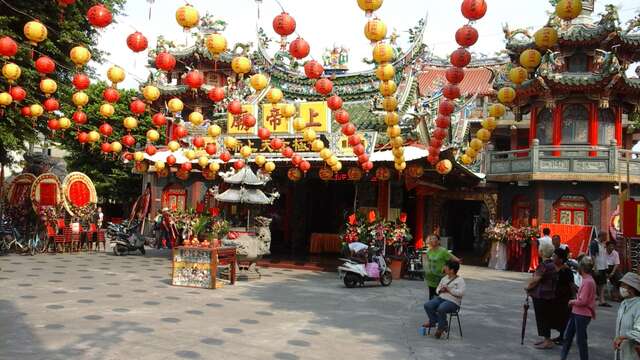
Degao Cuo Temple Introduction
Degao Cuo, originally named Zhugao Cuo, is located at the top of Kanding Mountain, where the towering thorny bamboo resembles a standing bamboo pole. During the Cheng dynasty period of Taiwanese rule, this village had no Han settlers yet. Renhe Village had Xiaban to the south of Hutou Mountain and Dalin Village to the north. Shortly after the Qing Dynasty began, Chen Yuanheng from Nanan County, Quanzhou, led a group to settle here, naming it Zhugao Cuo. Subsequent settlers included the Chen family from Tong'an County, Quanzhou, the Wang family from Nanan County and Jinjiang County, the Liu and Lin families from Jinjiang County, as well as the Cai family from Longxi County, Zhangzhou. They either moved in directly or relocated from other areas, leading to a gradual increase in population. Initially, no temple was built, and they continued to pay respects at the Xiaban Tian Gong Temple. Some may have invited the deity’s incense or even carved an idol for worship at home, celebrating the deity’s birthday each year. In the 40th year of the Qianlong reign, a severe epidemic struck, and the home-based deity worship could not suppress it. Villagers then went to Xiaban, specifically to Kanjiao Temple, to invite the Tian Gong’s statue into the village to dispel the plague, which ultimately succeeded. After the period of calm, elder Chen Yuqiong proposed the construction of a temple to honor Tian Gong. In the 46th year of the Xinchou year, it was completed, with the Chen family also offering an incense burner, inscribed with "Xuantian Shangdi" on the top, "Renhe Village" on the left, and "Degao Cuo" on the right, marking the beginning of the temple's construction.