Zheng Family Ancestral Hall in Guanshi Introduction
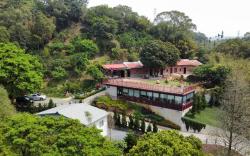
Guanxi is located northeast of Hsinchu City, and it is an important town in the upper reaches of the Fengshan River. Before the arrival of Han settlers in the early Qing Dynasty, this area was inhabited by the Pingpu tribe, specifically the Zhuqian community. Han settlers began to cultivate the land during the Jiaqing and Daoguang eras, primarily moving up the Fengshan River from the Hsinchu Plain. Guanxi is a key route into the interior mountains, thus a fort was established for protection. The streets of Guanxi include both the old street and the new street. The old street was established in the 17th year of Jiaqing (1812), and the new street, known as Xian Cai Peng, was founded in the second year of Daoguang (1822). The Zheng family in Guanxi migrated from Raoping, Guangdong to Taiwan for agriculture. The family's sixth ancestor, Zheng Qingya, came to Taiwan in his youth, settling in the area near the Qiao head under Yingge's Jianshan. By the ninth ancestor, Zheng Chengwu, who moved to Toucheng in Lanyang during the late Qianlong period, the family operated a gold shop and cultivated areas such as Erjie, Sanjie, and Sijie, gradually accumulating wealth. Due to fears of being implicated in conflicts between Fujian and Guangdong, the family moved in the 14th year of Daoguang (1834) to the preserved farmland near the North Gate of Guanxi. In addition to purchasing land and houses, the Zheng family also built the Zheng's Xiangyang Temple around this time. Legend has it that at the beginning of its construction, a geomancer suggested adopting a Feng Shui orientation of "Chou Mountain and Gen," slightly favoring the north for financial fortune. However, the family decided to adopt "Gen Mountain and Chou," oriented northeast facing southwest to promote scholarly achievements, reflecting the family’s emphasis on the imperial examination and the education of its descendants. The Zheng's temple and the Luo family shrine are both located near the North Gate, on higher ground, allowing an early view of Guanxi street, the river valley, and the distant mountains, taking advantage of the beneficial Feng Shui concepts. The Zheng's temple is a typical sanheyuan (three-part courtyard), referred to in Hakka as "zhengwu dai zuoyou hengwu." Behind the temple is a small mound known as "huatai" in Hakka architecture, with a lush lychee tree at its center. The back of the temple features a retaining wall made of cobblestones, a common technique in Hakka regions. In the past, temples or family shrines not only served as places of ancestor worship but also had functions similar to those of temples, encompassing education, culture, and public activities. For the enlightenment education of children, the shrine served as a private school; for local celebrations and festivals, it served as an event venue. Disputes among clansmen were also settled at the shrine. Some larger shrines even had attached stages where opera troupes were invited to perform at scheduled times, allowing the clan members to get together, creating a warm and inviting atmosphere.