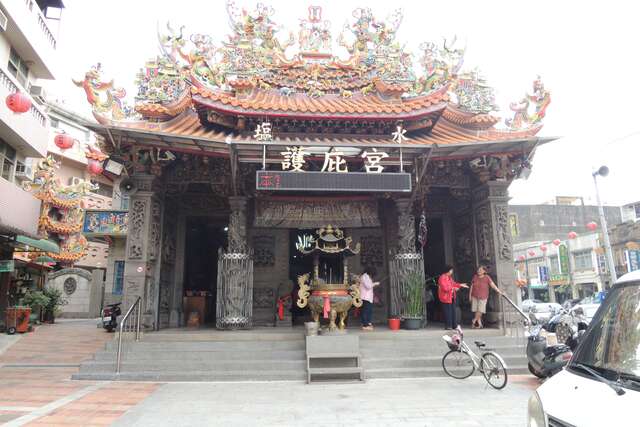
Houbi Temple Introduction
Yanshui Hupi Temple is dedicated to the Tian Shang Sheng Mu (Mazu). Yanshui was historically known as "Yuegang" or "Yuejin Port," and is one of the ports of the inner sea of Dapeng Bay. In terms of the prosperity of the port, there is a saying: "One府 (Fu), two 鹿 (Lu), three 艋舺 (Mengkiao), four 月津 (Yuejin)." Most of Taiwan's ancient ports built a Mazu temple to bless fishermen and merchant ships for safety at sea, serving as a spiritual support for those at sea. The numerous Mazu statues preserved in the temple attest to this, originating from offerings made by sugar merchants, grocery merchants, textile merchants, and water and oil merchants during the Qing Dynasty. The architecture of Yanshui Hupi Temple is ancient and simple, with decorations crafted by renowned artisans. The stone carvings are from the Chen family of Dadaocheng in Taipei, wooden carvings are by Chen Ren-shui from Tianzhong, paper cutting is by Yeh Jin-yi from Anping, and the colorful paintings include four murals by Pan Li-shui. It can be said to be a culmination of exquisite craftsmanship passed down through various fields from the Qing Dynasty to the post-war period.