Zhang Family Temple in Xinpu Introduction
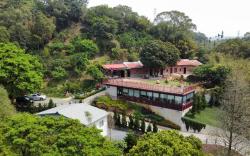
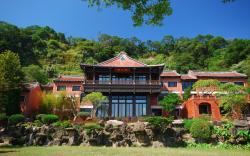
The Xinpuxi area was originally inhabited by the Takasago people, led by the local chief Ah Gui and Qian Zi Bai, who settled here and established it as a residence for the Pingpu people, originally known as "Ba Li Guo." During the Qianlong period of the Qing Dynasty, individuals from Guangdong began to cultivate the land, leading to the area's renaming to Xinpuxi. Due to its favorable geographical location, it gradually developed into a bustling market town. The Zhang Family Temple is located to the south of Xinpuxi Street, surrounded by fertile fields and an excellent environment. However, with the rapid development of the town, only narrow alleys now connect to He Ping Street. The Zhang Family Temple, commonly known as Zhang's Ancestral Hall, was founded by Zhang Yunlong in the seventh year of the Tongzhi era (1868) and completed in the ninth year of Tongzhi. It features a two-story, double-hall architectural style, which was quite magnificent at the time, but unfortunately, it was burned down by the Japanese army in the twenty-first year of Guangxu (1895). It was later rebuilt in the forty-first year of Meiji (1907) by Zhang Xiude, modifying it to a single hall with two wings, which is the appearance seen today. Zhang Yunlong, originally named Zhang Yumei, was born in the ninth year of Jiaqing (1804) and passed away in the sixth year of Guangxu (1880). He experienced the Daoguang, Xianfeng, and Tongzhi reigns, achieved the title of Gongsheng through merit, and was known for his heroism, exceptional talent, and sense of justice, becoming an important figure in the local area, alongside Chen Chao Gang as a wealthy gentleman of Xinpuxi. The Zhang Family Temple primarily enshrines the tablets of Zhang Yunlong's father, Zhang Linzhi, and the ancestors from the six branches of Zhang Linzhi's family. It serves as a typical ancestral temple for those who came to Taiwan, witnessing the development history of local families. Due to its historical value and uniqueness, it was designated as a county-level historical site in the 93rd year of the Republic of China.