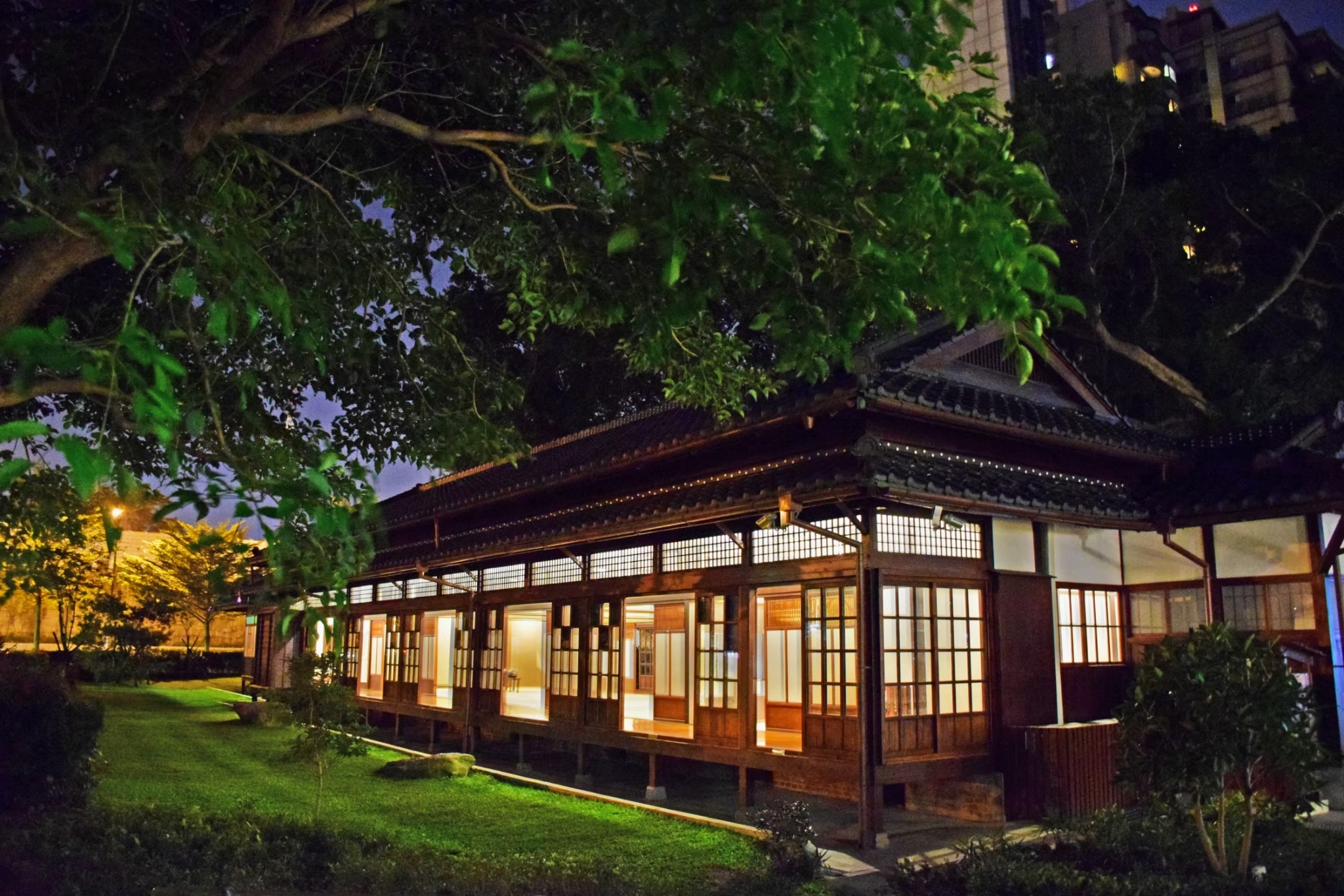
Kishu An Literature Forest Introduction
Kishu An was initially built in 1917 as a Japanese-style restaurant operated by the Ping-Sheng family, located by the scenic banks of the Xindian River, becoming a focal point for life in Southern Taipei. "Kishu" refers to a place name from Japan's Edo period, signifying the "Kishu Domain," which roughly corresponds to present-day Wakayama Prefecture. The Ping-Sheng family named the establishment "Kishu" to reminisce about their hometown in Japan. Originally, Kishu An was a two-story wooden restaurant with a thatched roof known as the main building (本館). As business improved, Kishu An was transformed into a three-story structure by Ping-Sheng De-Sheng between 1927 and 1928, along with the construction of auxiliary buildings and a separate guesthouse. During World War II, this location served as a residence for "kamikaze" pilots before executing their suicide missions. In the 1950s, post-war Kishu An was repurposed as a residence for civil servants, where novelist Wang Wen-Hsing once lived, and some scenes from his work "Family Changes" were based here. The main building and the annex were almost completely destroyed by two major fires in 1996 and 1998, leaving only the dilapidated guesthouse (now a historic site) with a leaking roof and damaged beams. Starting in late 2002, efforts were made by the National Taiwan University Department of Urban Planning, the Tong'an Cultural Forest Promotion Association, and later the Southern Riverside Cultural Association to protect the old trees and connect the rich literary heritage of Kishu An and its surroundings. In 2004, the Taipei City Government designated Kishu An as a city historical site. In 2011, a new building was established next to the historic site, managed by the Taiwan Literary Development Foundation under the guidance of the Taipei City Government's Culture Bureau, named the "Kishu An Literary Forest," which conducts literary exhibitions and promotion activities. In 2013, the Taipei City Government's Culture Bureau began restoration work on the Kishu An historic site, which lasted over a year, with the grand reopening taking place on May 25, 2014. The restored Kishu An historic site retains the original layout used by the restaurant, consisting of five twelve-tatami rooms, a rare type of Japanese architecture in Taiwan. The area currently includes a separate three-story main building that complements the historic site. As Taipei's first venue named after "literature," Kishu An collaborates with "Literary News," the most substantial journal on contemporary Taiwanese literature, and the Taiwan Cultural Information and Service Center, which has long collected and organized Taiwanese literary and author data. With this rich foundation, Kishu An communicates and showcases the trajectory of Taiwan/Taipei's literary history not only through the power of words but also through various cultural forms and creative expressions. It has hosted over 6,000 cultural events, becoming a literary hub in Taipei and continuously crafting a beautiful literary landscape in Southern Taipei.
 Kishu An Photo_03
 Kishu An Photo __01