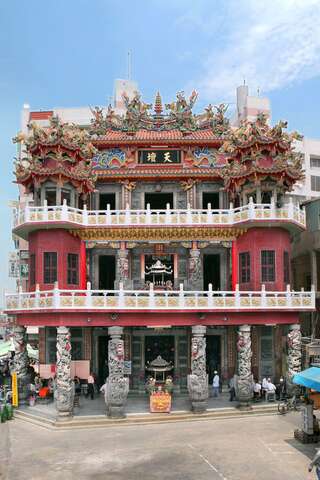
Tiangong Temple Introduction
The original name "Hua'an Temple" (formerly known as Wang Gong Miao, also referred to as Wang Gong Hall) primarily worships the National Guardian Lord (an official during the Eastern Jin dynasty, known as Xie An, who served as the Grand Tutor and was also known by his courtesy name Anshi). He, along with Xie Yuan Shuai (the Eastern Jin General, son of Xie Yi, brother of the renowned Xie An, and was granted the front flag), are both celebrated heroes of the Battle of Feishui. The National Guardian Lord was brought to prominence in Taiwan by Zheng Chenggong (Koxinga) during the late Ming dynasty, when his subordinate, who bore the surname Xie, welcomed the deity from Longxi County in Zhangzhou, Fujian. The temple's records are scarce, and only fragments remain, passed down through the memories of predecessors. According to the Newhua Town Records, in the twelfth year of the Jiaqing reign (1807), the county scholars Xie Jinluan and Zheng Bingcai collaboratively compiled the "Continued Edition of Taiwan County Annals," mentioning that the county magistrate Xue Zhiliang compiled the governance records, which noted, "The temple of Xie Dongshan is located in Damujiang Zhuang (worships Jin's Xie An, commonly referred to as Wang Gong Miao, with no records available regarding its inception. In the twenty-ninth year of the Qianlong reign, locals led by Yao Xingbang proposed reconstruction, and in the fifty-ninth year, Chen Guangmiao and others renovated it again)." The records from that period, along with the references to Wang Gong Hall and the Guanyin Hall, indicate that both were historically significant establishments, flourishing early on during the Qing dynasty in Damujiang Street. Therefore, it can be concluded that Wang Gong Temple (Hua'an Temple) was indeed established as an ancient temple during the Kangxi period. It is evident that in the sixth year of the Daoguang reign (1826), a formal temple was constructed at the current site for worship, marking its first significant establishment rather than being newly constructed.