Xu's Bamboo Pavilion Introduction
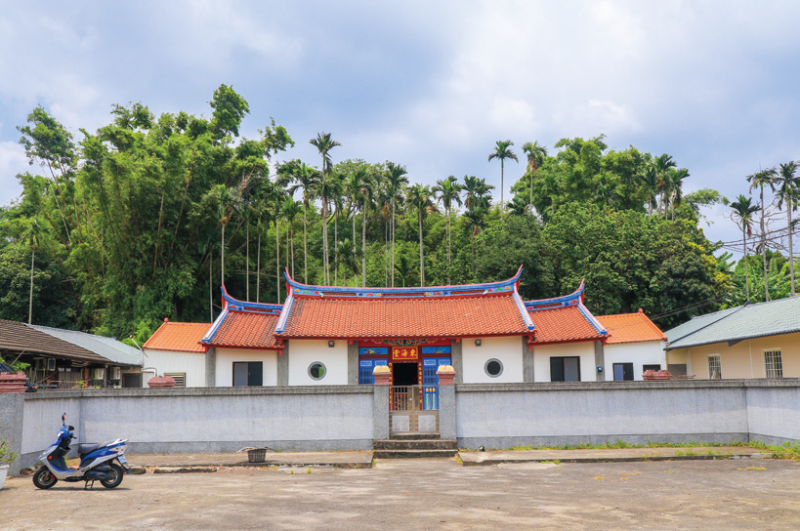
Located to the north of Tou House Junior High School, it was said that in the past, the area was surrounded by bamboos, hence it was named "Bamboo Pavilion." Another theory suggests that the Xu family, being a scholarly family, produced many literati during the late Qing Dynasty and Japanese colonial period. The Xu family was situated on the southern bank of Longjing Lake, where they built several bamboo pavilions to entertain poets, thus the name. The Bamboo Pavilion Xu residence traces its ancestry to Jiaoling, Guangdong. Its 14th-generation ancestor, Xu Haomin, crossed the sea to Taiwan during the Qianlong period and settled in the present-day location of Kantou, Miaoli. It was initially built during the Guangxu period and underwent slight repairs after the earthquake in the 24th year of the Republic, remaining relatively intact today. The front courtyard is divided into inner and outer areas, with a stone flag holder for tribute on the right side of the outer courtyard. The roof features a swallowtail design, and the main hall’s doors and windows are elegantly carved, with intricate floral decorations. The hall enshrines the ancestors of the Xu family, and the back door of the main hall is behind the deity altar, a layout that is quite rare. Not far from the Xu residence is Longjing Lake, located at the confluence of Laotianliao Creek and Houlong Creek. It is a deep pond that once had a wide surface, serving as the best place for local residents to hold dragon boat races and for literati to row boats and enjoy the moon while composing poetry. Therefore, “Dragon Pond Moonlight” was once one of the Eight Scenic Spots of the area.