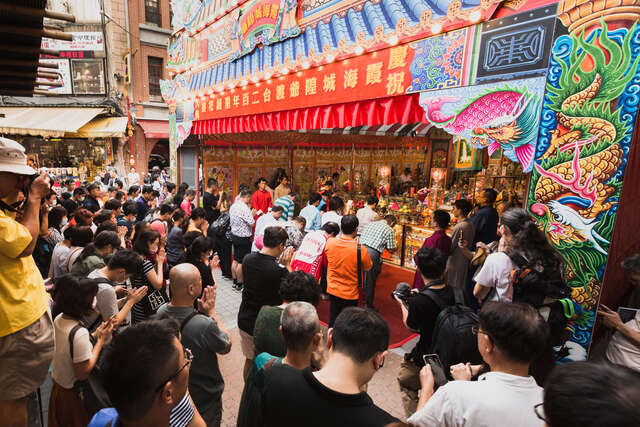
Xiahai City God Temple Introduction
The Xiahai City God Temple, located on Section 1 of Dihua Street, was built in 1856 (the sixth year of the Xianfeng reign). It covers an area of about 46 pings. Although it does not have an imposing temple facade, its faith community is extensive and its incense offerings flourish. Every time there is a deity-welcoming event, it is always lively and a major local event, closely related to the development of Dadaocheng. The main deity worshipped in the temple is Xiahai Chenghuang (City God), along with two judges (literary and martial), Generals Xie and Fan (Seventh and Eighth Lords), and thirty-eight righteous warriors. Other deities include the City God’s wife, eight officials, eight generals, the horse driver, and the Elder under the Moon. This famous ancient temple currently houses around 200 deities, making it one of the densest temple complexes in Taiwan. Among the attractions for tourists in the Xiahai City God Temple, aside from the City God, the most popular is the worship of Yue Lao (the God of Marriage). Each year, over 6,000 couples come to express their gratitude, and the most sought-after item is the "Yufu Shoes" (also known as "Happiness Shoes"), which is Taipei's renowned "Love Amulet." On average, more than 200 families visit Xiahai City God Temple each year to "request shoes." According to legend, the City God and his wife have an age difference of about 70 years, and under the notion of "the old husband cherishing his young wife," the public firmly believes that this pair of "divine partners" can bring happiness to families, giving rise to the origins of the "Yufu Shoes." Additionally, there is a miraculous story associated with the City God Temple. In 1884, during the Sino-French War, French troops attacked Taiwan. At that time, the people of Taipei earnestly prayed for the protection of Xiahai City God. The City God indeed displayed divine power, and ultimately, the French troops were defeated at Wudu and failed to seize Taipei, which led to the local reverence for Xiahai City God as "Weiling Gong."