Xiangtian Lake Introduction
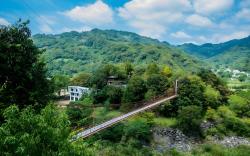
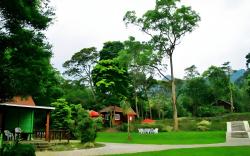
Located in Donghe Village, Nanzhuang Township, Miaoli County, it currently has over twenty households with a population of around two hundred, making it the largest settlement of the Saisiyat people. Legend has it that hundreds of years ago, this place was a lake, and the ancestors named it Xiangtian Lake (also known as Yangtian Lake) because they saw the sky reflected on the water. Later, a tributary of the Datu River eroded the shores of the lake, causing the water to drain away, leaving behind fertile lakebed soil that became a mountain basin. The indigenous people who moved here transformed it into farmland. Xiangtian Lake is situated at an altitude of 738 meters and is bordered to the southeast by the Guangtian Mountain ridge and Luchang, while it connects to Penglai Village in the southwest and faces Nanjing Village and Donghe Village to the northwest. Guangtian Mountain is a sub-ridge of the Jiali Mountain Range, characterized by steep cliffs eroded by the Datu River on the east side, while the west side has gentle slopes and a wider ridge. Xiangtian Lake is located in the western foothills, with terraced fields spread throughout the basin, surrounded by cypress forests, mixed woodlands, and bamboo groves, creating a lush green landscape. Due to its higher elevation, it is often shrouded in mist during the winter and spring, with ethereal clouds resembling a fairyland. The Xiangtian Lake hosts a ritual every two years and a grand ritual every ten years known as the "Ailing Festival," which carries profound historical significance and a primitive mysterious atmosphere, making it the most important festival for the Saisiyat people. The Ailing Festival takes place around the 15th day of the lunar calendar in October and lasts for four days and three nights. The Saisiyat people hope that visitors will come with sincere respect for indigenous culture to preserve the original appearance of the Ailing Festival. Origin of the Ailing Festival: In ancient times, the black dwarfs, who were less than one meter tall, possessed various skills. They taught the Saisiyat people farming and ritual practices, providing them with stable livelihood skills. During harvest time, the Saisiyat would invite the dwarfs into their village to celebrate the bounty; however, over time, the invited dwarfs behaved improperly towards Saisiyat women. One year during the harvest festival, the Saisiyat devised a trap that led to the death of the dwarfs. Following this incident, the harvest was not as bountiful as before, and to appease the deceased dwarfs, the Saisiyat conducted the "Ailing Festival," celebrated in mid-October of the lunar calendar, which has since transformed from an annual celebration to a small festival every two years and a grand festival every ten years.