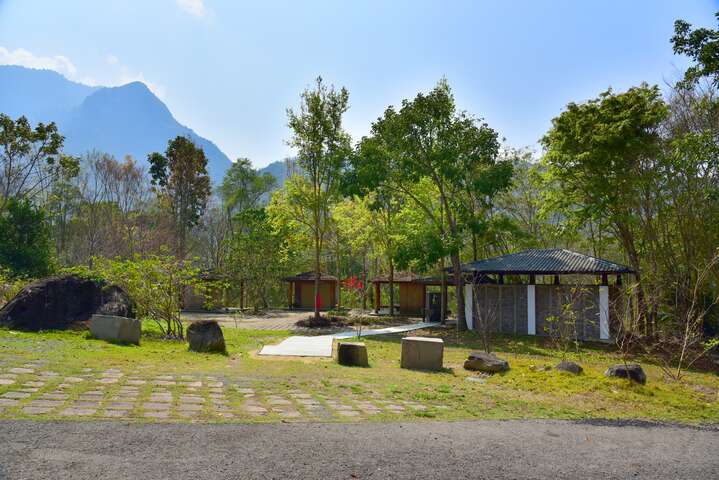
Debris Flow Memorial Park Introduction
The "Debris Flow Memorial Park," located at the entrance of Fengshan Village, was once a vibrant and lush forest teeming with life. What seems like naturally occurring massive stones on the surface actually conceals a long story of coexistence between this land and nature. The residents of Fengshan Village (Shigupan) represent a diverse background shaped by over a century of ethnic and geographical memories. During the Japanese colonial period, the development of the camphor industry attracted Hakka people from the mountainous areas of Hsinchu, as well as residents from nearby Ruiri, Ruifeng, and Taixing to settle here. Initially, the early pioneers of land reclamation were not fully aware of the origins of the massive stones hidden beneath the dense forest, until recent years when frequent typhoons and heavy rainfall posed challenges, leading to geological investigations that confirmed these landforms were the result of large-scale debris flows occurring over a century ago. This geological discovery also unveiled ancient ethnic mysteries: the Tsou people (originally known as the "Qiyana" community), who lived here long ago, had to relocate due to the severe debris disasters they faced. The existence of this park unites different ethnic groups on the same land, showcasing the resilience of their struggle against nature and their journey towards harmonious coexistence. In 2003, government agencies established the "Debris Flow Memorial Park" as the first station for disaster prevention education and life tours. The park is not only equipped with comprehensive recreational facilities but also features informative panels that detail the living history, industrial culture, and professional disaster prevention knowledge of Fengshan. This place serves not only as the first impression for entering Fengshan Village but also as the core site for community tours and environmental education. Through the observation of giant stones and landforms, travelers can deeply appreciate the importance of "coexisting harmoniously with nature" and feel the spirit of the people of Fengshan, who continue to resiliently protect their homeland after disasters such as Typhoon Herb and Morakot.