Lion's Head Mountain Historic Trail Introduction
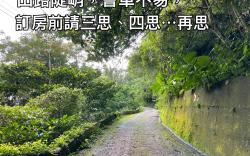
Lion's Head Mountain is located at the boundary between Nanzhuang Township in Miaoli County and Emei Township in Hsinchu County. The entire mountain is characterized by layered peaks and stunning rock formations, imbued with elegance and spirituality, making it a place of exceptional beauty. There are currently eleven temples situated within the mountain, most of which are built into natural caves, nestled among lush greenery in a harmonious arrangement that creates an ethereal atmosphere. It is known throughout Taiwan as a sacred site that promotes Confucianism, Buddhism, and Taoism. Lion's Head Mountain is filled with towering ancient trees that provide shade and tranquility, with its temples scattered around, radiating peace and serenity. On weekends, one can take a break here to rest for a night or for a short holiday, engaging in worship or meditation, where the sounds of morning and evening bells help wash away all worldly concerns, making it a solemn and tranquil destination for visitors. As one of Taiwan's twelve scenic spots, Lion's Head Mountain lies between Nanzhuang and Emei Townships. The southern section belongs to Nanzhuang Township, while the northern section is within Emei Township. To the south, steep cliffs face the Elephant Trunk Mountain across the Sanwan River, while the northern slopes rise and fall around the Liu Liao village in the wavy terrain, resembling a crouching lion. During the Daoguang period of the Qing Dynasty, the Tamsui County Chief Li Shenyi named it "Lion's Head Mountain" due to its shape. Lion's Head Mountain has an elevation of 496 meters and features a standard hogback ridge, often shrouded in mist with mountain valleys appearing like a coiled dragon; bamboo groves and other trees grow among the rocky terrain. The winding stone paths weave through dense forests, rarely seeing daylight, remaining cool even in summer. The cliffs along the ridge rise several tens of feet tall. The Lion's Head Mountain trail marks the boundary between Hsinchu and Miaoli counties at the Wang Yue Pavilion and is divided into two parts: the front mountain of Nanzhuang Township and the back mountain of Emei Township. The front mountain segment has a well-preserved stone staircase with over a thousand steps; the back mountain has been entirely converted to a cement path, retaining only small sections of stone steps in front of the temples. The terrain on the front mountain is steeper and more challenging, while the back mountain features gentle slopes that are easier to navigate. Before 1965, visitors had to climb up through an old trail to reach the attractions such as Raoyi Temple, the Spirit Tower, and the Quanhua Hall, as the surrounding road was not yet built. This stone pathway has been popular for decades among hikers and fitness enthusiasts, with dancing bamboos and murmuring streams alongside unique rock formations. With a normal pace, it takes about twenty minutes to reach the Quanhua Hall. Nowadays, most visitors park in the square below Quanhua Hall and start their walk through the Hexagonal Pavilion to Fujitian Palace, then up to Quanhua Hall. By turning left at the Dao De Men, one can reach the Sarira Cave and Kaishan Temple, which are a ten-minute round trip. Continuing forward directly leads to a climb up the Daya Cliff to Wang Yue Pavilion, which is about 600 meters long and takes roughly twenty minutes. The stone steps leading to the Zen path on the front mountain, apart from a few sections awaiting repair, are relatively complete and easy to walk on. Starting from Wang Yue Pavilion, the gentle slope descends towards the Lion's Tail Trailhead, encompassing about three kilometers, all along a cement farm road. Along the way, there are several temples: Shiyan Cave, Haihui An, Lingxia Cave, Jingang Temple, and Wanfo An, leading from the Lion's Tail Trailhead to Fanyin Temple (Shuilian Cave). Among these, Yuanguang Temple, built 107 years ago, is the oldest Buddhist temple in the Lion's Head Mountain area, followed by Quanhua Hall, which is 101 years old, both holding significant historical meaning.