Liu Wang Tomb Park Introduction
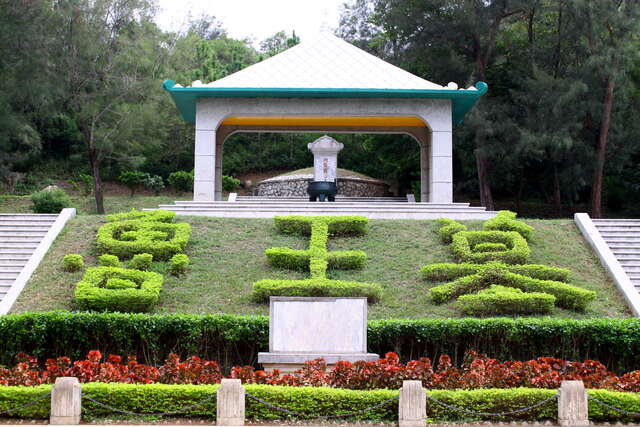
The Ming Lu King Tomb is located at the southwestern foothills of Mount Taiwu, backed by the mountain and facing Shuangru Peak, offering a view of the mainland's mountains and rivers. The tomb is constructed in a tiered arrangement that follows the natural terrain, starting with the archway, followed by the Huanggai Pavilion, which houses a thousand-pound cauldron, and ultimately leading to the circular new tomb made of stone blocks. The Ming Lu King Tomb was established in the 48th year of the Republic of China, based on the directive of President Chiang Kai-shek, and the burial ceremony took place in the 52nd year. The surrounding environment of the cemetery is serene. On August 22, 1959, the National Army discovered an ancient tomb while blasting mountains for stone mining east of Old Jinmen City. A stone tablet was found in a stone chamber, and after deciphering the inscription, it was revealed to be the tomb record of the Ming Dynasty Regent King Lu. Other discoveries included the Yongli Tongbao coins and square bricks. The inscription details the life events of King Lu and provides evidence that his death was not as stated in Qing Dynasty literature, which claimed he was murdered by Koxinga, but instead was due to asthma. This finding cleared Koxinga of years of unjust blame. Furthermore, it was discovered that Koxinga passed away before King Lu.